You’ve done the Zoo. You’ve eaten fish tacos on every pier from Pacific Beach to Coronado. You know where to watch the sunset and which freeway on-ramp to avoid at 5pm. But San Diego has a way of hiding things in plain sight — places that have been here for decades, sometimes over a century, that most locals have never heard of, let alone visited.
We’re not talking about “hidden gem” restaurants or a beach you haven’t tried yet. These are genuinely strange, beautiful, and historically wild places scattered across the county that will make you say, “Wait, that’s been here the whole time?” Here are five of them.
Table of Contents
Spruce Street Suspension Bridge: A 112-Year-Old Secret in Bankers Hill
There is a 375-foot suspension bridge hanging 70 feet above a canyon in one of San Diego’s most walkable neighborhoods, and the vast majority of people who live here have no idea it exists. The Spruce Street Suspension Bridge was built in 1912 — making it older than most of the city’s infrastructure — and it’s been quietly swaying over Kate Sessions Canyon in Bankers Hill ever since.
And yes, it sways. That’s part of the experience. The wooden-planked footbridge was designed by Edwin Capps, a self-taught engineer, and the gentle side-to-side movement as you cross is by design, not decay. It connects the east and west sides of Spruce Street across a lush canyon filled with eucalyptus and palm trees. The whole crossing takes about two minutes, but you’ll stand in the middle for longer than that, looking down into the green canopy wondering how you’ve driven past this neighborhood a hundred times without knowing this was here.
It’s free, open daily from 6am to 10pm, and there’s street parking on either end. Best visited in the morning when the light filters through the canyon, or at dusk when the bridge feels like it belongs in another century entirely — which, technically, it does.
Spruce St between Front St & Brant St, Bankers Hill
View this profile on InstagramHidden San Diego™ (@hiddensandiego) • Instagram photos and videos
Queen Califia’s Magical Circle: A World-Class Sculpture Garden in Escondido
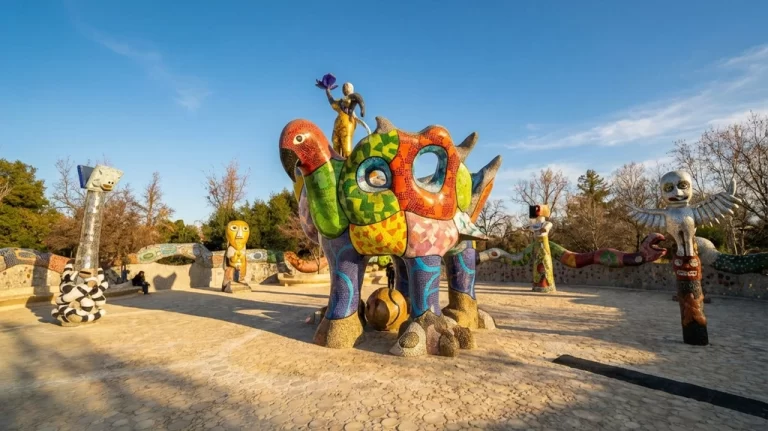
Tucked inside Kit Carson Park in Escondido, there is a massive outdoor sculpture garden by Niki de Saint Phalle — one of the most celebrated artists of the 20th century — and it is the only sculpture garden she ever created in the United States. Queen Califia’s Magical Circle features nine towering, mosaic-covered sculptures inspired by California’s mythological origin story (yes, California was named after a fictional Black queen), surrounded by a serpentine wall covered in mirrors, glass, and handmade ceramic tiles.
The centerpiece is Queen Califia herself, riding a giant eagle, flanked by totemic figures that feel like they belong in a dream sequence — part Gaudí, part fever dream, part pure joy. De Saint Phalle worked on this piece for years before her death in 2002, and it opened to the public in 2003. The Gaudi comparison isn’t hyperbole — this is genuinely world-class public art, the kind of thing people travel internationally to see, sitting quietly in a suburban park that most San Diegans have never visited.
Free admission. Open Tuesdays and Thursdays 9am–noon, plus the second and fourth Saturdays of each month 9am–2pm. Closed after rain (the mosaic tiles get slippery). Worth the drive to Escondido — pair it with lunch in the Escondido food scene and you’ve got a full day.
3333 Bear Valley Pkwy, Escondido (inside Kit Carson Park)
View this profile on InstagramVisit Escondido (@visitescondido) • Instagram photos and videos
USS Recruit: The Navy Ship That Never Touched Water
At Liberty Station in Point Loma, there is a two-thirds-scale destroyer escort sitting on dry land, surrounded by restaurants and retail shops, as if someone just forgot to put it in the ocean. The USS Recruit was commissioned in 1949 as a fully functional training vessel for the Naval Training Center — recruits would learn seamanship, navigation, and damage control on this ship without ever leaving shore. It was the only commissioned Navy ship in history that never touched water.
For decades it was a training tool, then an administrative building, then mostly forgotten behind a fence. In 2023 it was finally opened to the public as a museum, and now you can walk aboard, explore the deck, and learn about the thousands of sailors who trained here. The ship is 225 feet long and looks absolutely surreal sitting in the middle of what is now a shopping and dining complex. Most people walking through Liberty Station don’t even glance at it — which is a shame, because the story behind it is one of the weirdest and most charming military footnotes in San Diego history.
2558 Laning Rd, Liberty Station, Point Loma
View this profile on InstagramLiberty Station (@libertystation) • Instagram photos and videos
Harper’s Topiary Garden: 50+ Living Sculptures in Mission Hills
On a quiet residential street in Mission Hills, there’s a front yard that looks like it fell out of a Wes Anderson movie. Harper’s Topiary Garden is the lifelong project of Edna and Alex Harper, who spent decades hand-trimming over 50 plant sculptures out of their hedges — elephants, dinosaurs, geometric shapes, spirals, and forms that defy easy categorization. It’s whimsical, meticulous, and completely unexpected on an otherwise normal residential block.
Edna Harper continues to maintain and evolve the garden, which has been growing and changing since the Harpers first started shaping their bushes decades ago. There’s no admission fee, no sign out front, and no hours — it’s just someone’s yard. You view it from the sidewalk, and most people who stumble across it do so completely by accident while walking through the neighborhood. The garden was featured by Axios San Diego in February 2025 and has quietly become one of San Diego’s most photographed private properties, despite most of the city having no clue it’s there.
3549 Union St, Mission Hills
View this profile on InstagramMission Hills San Diego (@missionhillssd) • Instagram photos and videos
SS Monte Carlo: A 1930s Gambling Ship Wreck on Coronado’s Beach
In the 1930s, a 300-foot concrete-hulled ship called the SS Monte Carlo operated as a floating gambling casino, dance hall, and — depending on who you ask — brothel, anchored just outside the three-mile limit off Coronado to skirt California’s anti-gambling laws. On New Year’s Day 1937, a storm snapped its anchor chain and drove it ashore at Silver Strand State Beach. Nobody bothered to salvage it. The gambling operation was over, and the ship was left to rot in the sand.
Nearly 90 years later, the wreck is still there — buried under the sand most of the time, but periodically exposed during extreme low tides and winter storms. When the sand shifts just right (usually after El Niño events or during January’s king tides), the rusted steel ribs and hull plating emerge from the beach like something out of a post-apocalyptic movie. It was last widely visible in January 2023, and it will surface again — you just have to watch the tide charts and be ready to go.
When it appears, head to Silver Strand State Beach southwest of the Hotel del Coronado, near the Coronado Shores condos. Wear shoes with grip — the exposed metal is rusty and algae-covered. Don’t climb on it. And take a moment to appreciate that you’re standing next to a genuine Prohibition-era sin ship that’s been slowly disappearing into a San Diego beach for almost a century.
Silver Strand State Beach, Coronado (near Coronado Shores, southwest of Hotel del Coronado)
View this profile on InstagramCoronado Island, California (@visitcoronadoisland) • Instagram photos and videos
San Diego has a way of keeping secrets even from the people who live here. If you enjoyed this list, check out more of our neighborhood guides and local life hacks to keep discovering the parts of this city most people walk right past.